Project type
UX research
Focus
Service usability testing
Role
Lead UX Researcher
Client
Tourism & Events NT
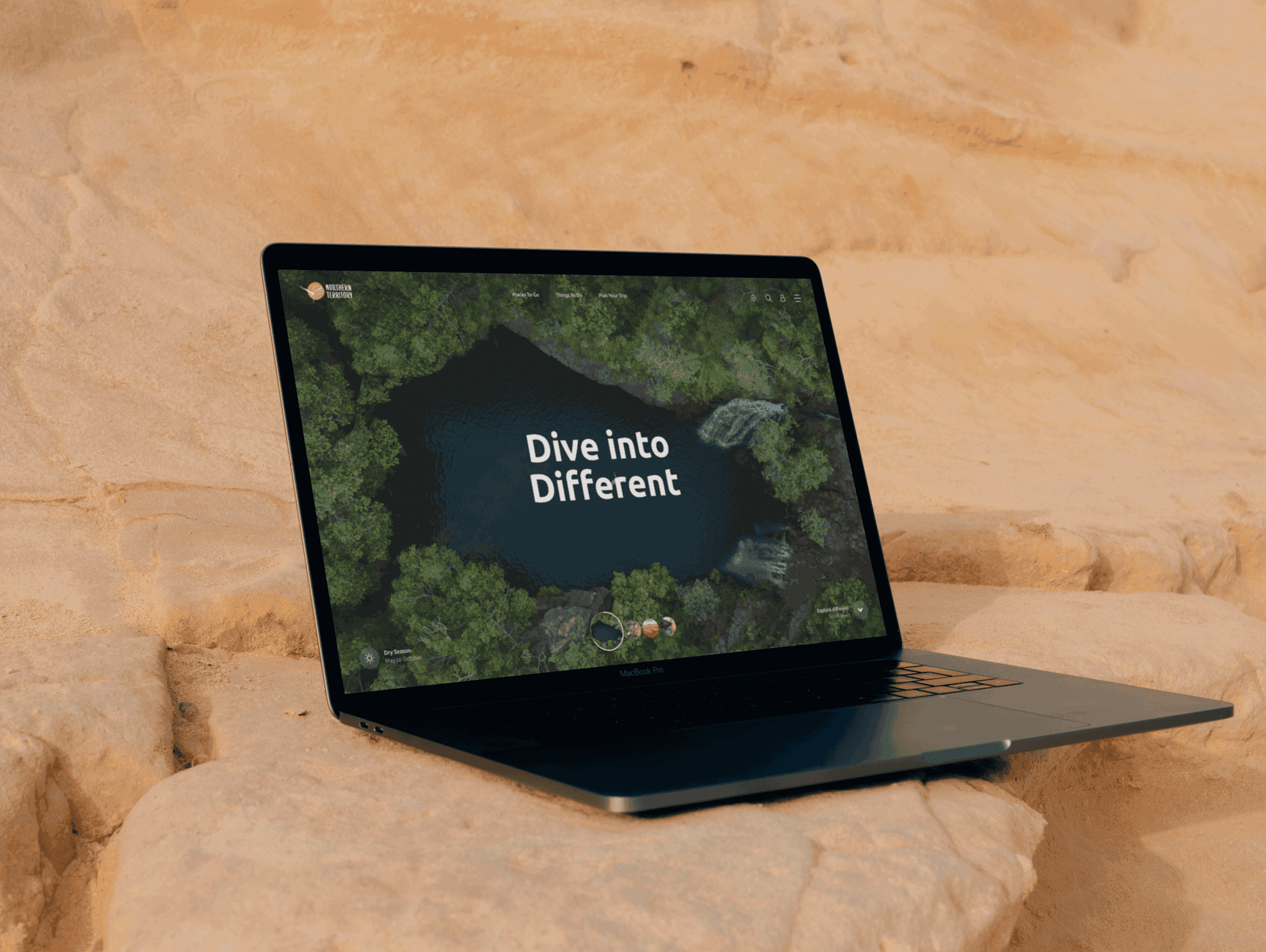
Northern Territory Tourism needed to evolve their website from a static content repository into a conversion-focused experience that could move users from dreaming to planning and ultimately to booking.
My role was to identify where conversion was breaking down and design a journey that positioned the site as a planning tool worth returning to.
An immersive loader concept designed to close the emotional gap revealed in testing. Competitor sites successfully created emotional connection through motion and storytelling, while NT's static approach fell flat. This transition immediately establishes the Territory as an experience worth exploring, not just information to consume.
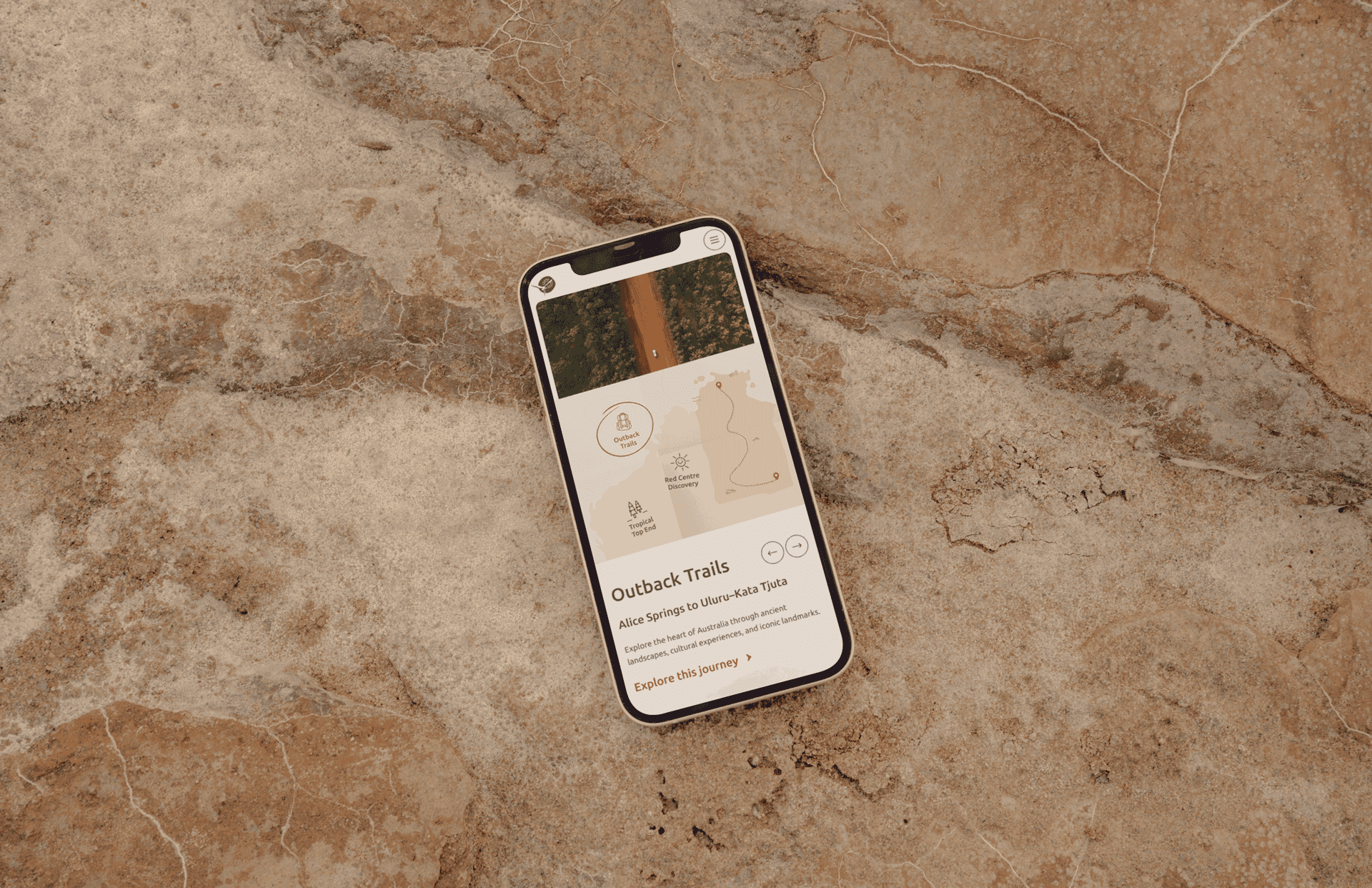
Illustrated trail maps designed to make planning feel tactile, human, and exploratory.
Design approach
Research and insight
I designed and conducted moderated research with 45 participants across six markets: Australia, Japan, Germany, New Zealand, the UK, and the USA. Testing focused on three intent stages: Dreaming, Planning, and Booking.
Each 45–60 minute session combined pre-test interviews, competitive benchmarking across six competitor sites, task-based usability testing, and post-task surveys. This produced more than 1,800 tagged observations.
Participants consistently rated the site as easy to use, yet struggled to complete basic navigation and booking-related tasks. Positive sentiment masked clear conversion barriers that only surfaced through behavioural testing.
Key issues included:
Unclear navigation language and patterns.
Critical booking information hidden behind tabs.
Dense pages that were hard to scan and visually uncompetitive.
Translation issues and broken search for international users.
Research and insight
I designed and conducted moderated research with 45 participants across six markets: Australia, Japan, Germany, New Zealand, the UK, and the USA. Testing focused on three intent stages: Dreaming, Planning, and Booking.
Each 45–60 minute session combined pre-test interviews, competitive benchmarking across six competitor sites, task-based usability testing, and post-task surveys. This produced more than 1,800 tagged observations.
Participants consistently rated the site as easy to use, yet struggled to complete basic navigation and booking-related tasks. Positive sentiment masked clear conversion barriers that only surfaced through behavioural testing.
Key issues included:
Unclear navigation language and patterns.
Critical booking information hidden behind tabs.
Dense pages that were hard to scan and visually uncompetitive.
Translation issues and broken search for international users.
Research and insight
I designed and conducted moderated research with 45 participants across six markets: Australia, Japan, Germany, New Zealand, the UK, and the USA. Testing focused on three intent stages: Dreaming, Planning, and Booking.
Each 45–60 minute session combined pre-test interviews, competitive benchmarking across six competitor sites, task-based usability testing, and post-task surveys. This produced more than 1,800 tagged observations.
Participants consistently rated the site as easy to use, yet struggled to complete basic navigation and booking-related tasks. Positive sentiment masked clear conversion barriers that only surfaced through behavioural testing.
Key issues included:
Unclear navigation language and patterns.
Critical booking information hidden behind tabs.
Dense pages that were hard to scan and visually uncompetitive.
Translation issues and broken search for international users.
Strategy and value proposition
I facilitated stakeholder workshops using Jobs-to-Be-Done methodology to align research insights with business goals. This resulted in a clear value proposition that guided all subsequent design decisions:
NT Tourism helps travellers confidently plan unique Australian adventures through inspiring content, practical planning tools, and seamless pathways to booking.
Strategy and value proposition
I facilitated stakeholder workshops using Jobs-to-Be-Done methodology to align research insights with business goals. This resulted in a clear value proposition that guided all subsequent design decisions:
NT Tourism helps travellers confidently plan unique Australian adventures through inspiring content, practical planning tools, and seamless pathways to booking.
Strategy and value proposition
I facilitated stakeholder workshops using Jobs-to-Be-Done methodology to align research insights with business goals. This resulted in a clear value proposition that guided all subsequent design decisions:
NT Tourism helps travellers confidently plan unique Australian adventures through inspiring content, practical planning tools, and seamless pathways to booking.
Information architecture and journey design
I led a stakeholder workshop to restructure the sitemap around user intent rather than content type. The existing structure created overlap and confusion. The revised architecture followed a clear journey of exploration, planning, and booking.
Using object-oriented UX principles, I wireframed 16 core templates and defined how destinations, experiences, events, and deals connected across the journey.
Information architecture and journey design
I led a stakeholder workshop to restructure the sitemap around user intent rather than content type. The existing structure created overlap and confusion. The revised architecture followed a clear journey of exploration, planning, and booking.
Using object-oriented UX principles, I wireframed 16 core templates and defined how destinations, experiences, events, and deals connected across the journey.
Information architecture and journey design
I led a stakeholder workshop to restructure the sitemap around user intent rather than content type. The existing structure created overlap and confusion. The revised architecture followed a clear journey of exploration, planning, and booking.
Using object-oriented UX principles, I wireframed 16 core templates and defined how destinations, experiences, events, and deals connected across the journey.
Deliverables
Concept and experience design
In parallel with research, KWP’s creative directors were developing a new brand campaign for NT Tourism. I worked closely with them to translate research insights into an experience moodboard that informed wireframing across campaign directions.
Key concepts included a personalised trip planner, seasonal and weather-aware content, an interactive map showing the Territory's scale, behaviour-driven activity recommendations, and a quiz-based planning entry point.
I designed two homepage concepts for desktop and mobile. Stakeholders responded positively to elements from both, which I refined into a single direction designed to stand out from competitors and encourage deeper exploration.
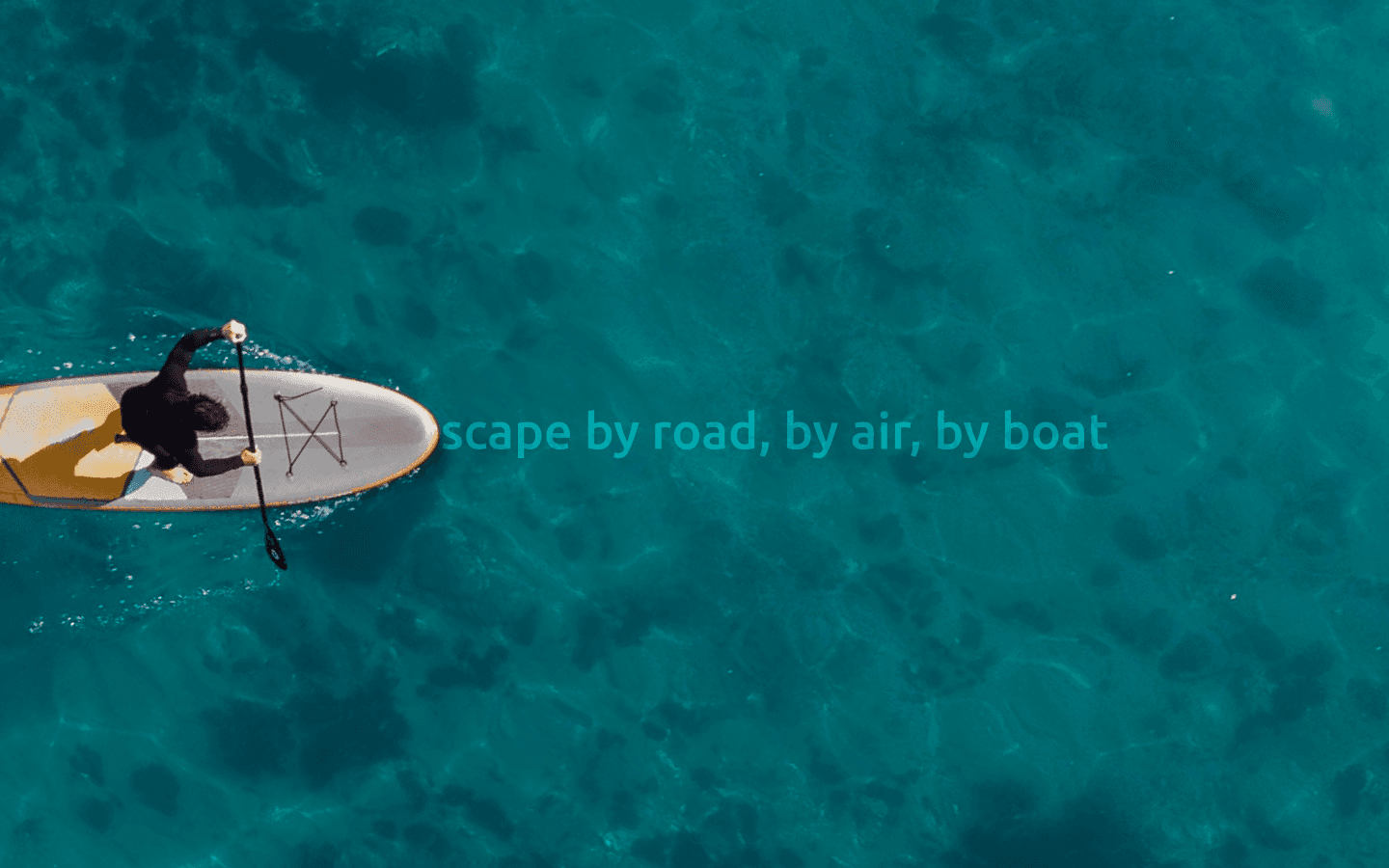
An interactive scroll moment where content changes as the user moves through the experience, reinforcing discovery through motion rather than static text.
Concept and experience design
In parallel with research, KWP’s creative directors were developing a new brand campaign for NT Tourism. I worked closely with them to translate research insights into an experience moodboard that informed wireframing across campaign directions.
Key concepts included a personalised trip planner, seasonal and weather-aware content, an interactive map showing the Territory's scale, behaviour-driven activity recommendations, and a quiz-based planning entry point.
I designed two homepage concepts for desktop and mobile. Stakeholders responded positively to elements from both, which I refined into a single direction designed to stand out from competitors and encourage deeper exploration.
An interactive scroll moment where content changes as the user moves through the experience, reinforcing discovery through motion rather than static text.
Concept and experience design
In parallel with research, KWP’s creative directors were developing a new brand campaign for NT Tourism. I worked closely with them to translate research insights into an experience moodboard that informed wireframing across campaign directions.
Key concepts included a personalised trip planner, seasonal and weather-aware content, an interactive map showing the Territory's scale, behaviour-driven activity recommendations, and a quiz-based planning entry point.
I designed two homepage concepts for desktop and mobile. Stakeholders responded positively to elements from both, which I refined into a single direction designed to stand out from competitors and encourage deeper exploration.
An interactive scroll moment where content changes as the user moves through the experience, reinforcing discovery through motion rather than static text.
Trip planner system
I designed a clickable prototype and system blueprint for a trip-planning tool. Core functionality included filtering by places and experiences, list and map-based planning views, and visual daily itineraries with auto-routing. Member features supported collaborative planning, saved trips, and publishing itineraries to a shared library.
User research validated strong demand for a logged-in planning experience, particularly among international travellers.
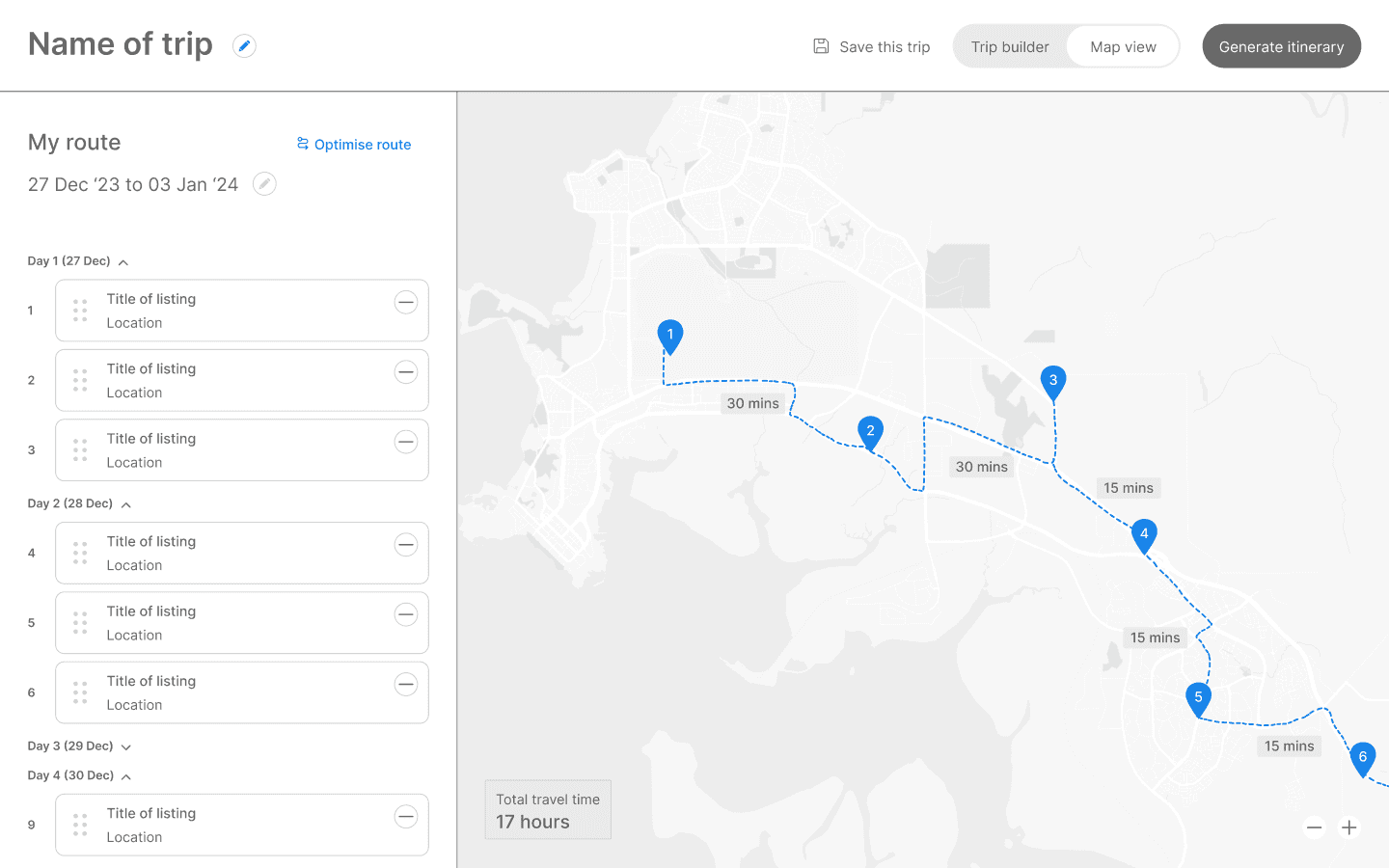
Clickable trip planner prototype combining list-based planning with a live map view, auto-routing, and daily itinerary structure to support multi-day travel planning.
Trip planner system
I designed a clickable prototype and system blueprint for a trip-planning tool. Core functionality included filtering by places and experiences, list and map-based planning views, and visual daily itineraries with auto-routing. Member features supported collaborative planning, saved trips, and publishing itineraries to a shared library.
User research validated strong demand for a logged-in planning experience, particularly among international travellers.
Clickable trip planner prototype combining list-based planning with a live map view, auto-routing, and daily itinerary structure to support multi-day travel planning.
Trip planner system
I designed a clickable prototype and system blueprint for a trip-planning tool. Core functionality included filtering by places and experiences, list and map-based planning views, and visual daily itineraries with auto-routing. Member features supported collaborative planning, saved trips, and publishing itineraries to a shared library.
User research validated strong demand for a logged-in planning experience, particularly among international travellers.
Clickable trip planner prototype combining list-based planning with a live map view, auto-routing, and daily itinerary structure to support multi-day travel planning.
Quick wins
Alongside long-term concepts, I identified immediate improvements that could be implemented with minimal effort. These included surfacing deals and FAQs previously hidden behind tabs, improving map pin contrast for accessibility, refining filters, and redesigning the newsletter module with a clearer value proposition.
Quick wins
Alongside long-term concepts, I identified immediate improvements that could be implemented with minimal effort. These included surfacing deals and FAQs previously hidden behind tabs, improving map pin contrast for accessibility, refining filters, and redesigning the newsletter module with a clearer value proposition.
Quick wins
Alongside long-term concepts, I identified immediate improvements that could be implemented with minimal effort. These included surfacing deals and FAQs previously hidden behind tabs, improving map pin contrast for accessibility, refining filters, and redesigning the newsletter module with a clearer value proposition.
Northern Territory Tourism took the research and designs in-house and delivered a new website aligned with these recommendations. Implemented features included interactive maps and itinerary tools, and a consolidated, intent-driven site architecture.
Following launch, time spent on site increased by 70 percent. Overnight trips rose 19 percent in 2025, with growth recorded across tested markets, including the USA, the UK, and Germany.